Sourced, not summarized
Uphold spreads and fees, from the source
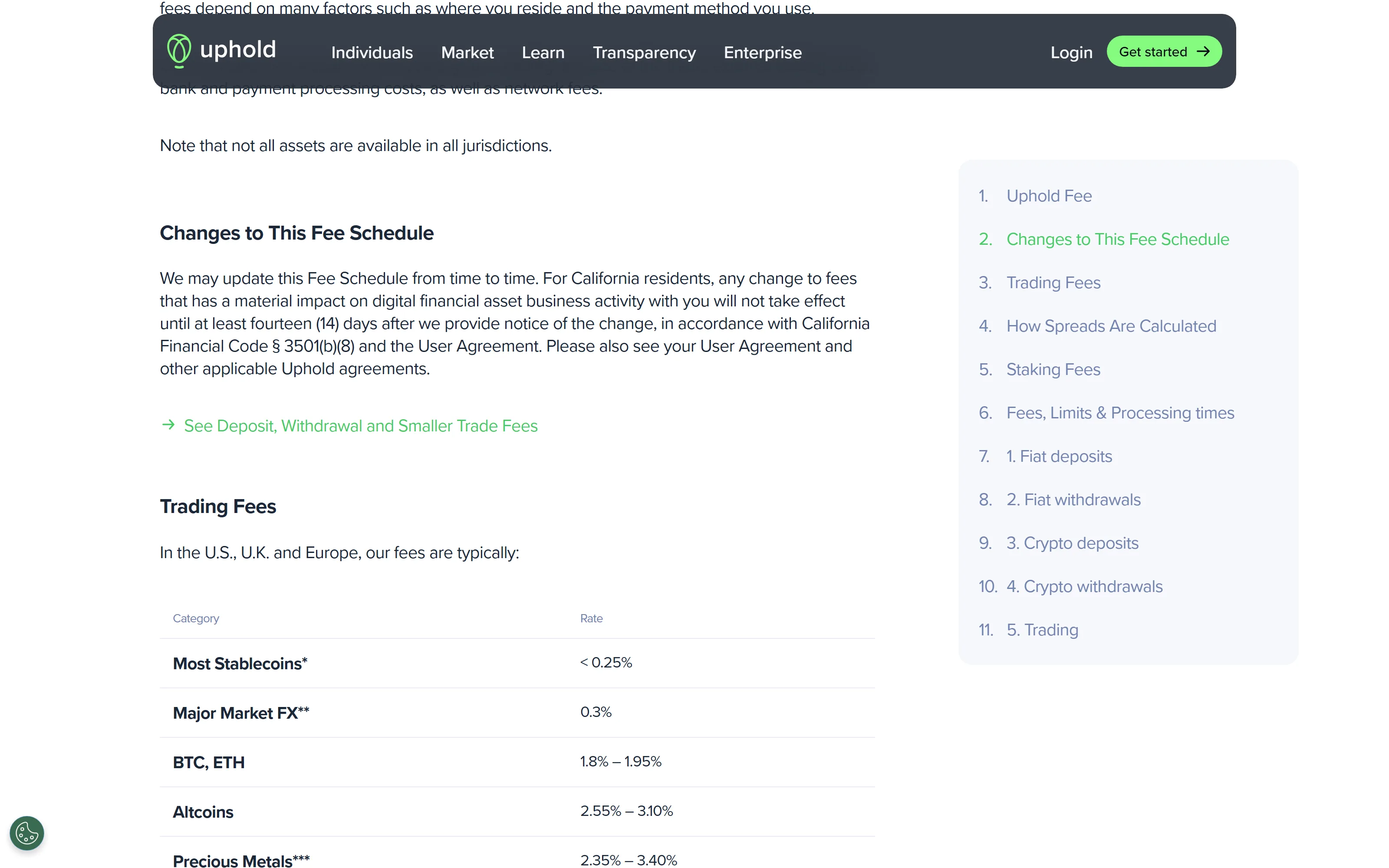
| Pricing model | Spread inside the quote, no separate commission |
|---|---|
| Most stablecoins | Under 0.25% |
| Major market FX | 0.3% |
| BTC, ETH | 1.8% to 1.95% |
| Altcoins | 2.55% to 3.10% |
| Precious metals | 2.35% to 3.40% |
| Trades under $500 | Plus a $0.99 fee, with exclusions |
| Conversions | Charged at the higher of the two asset rates |
| Quote hold | 18 seconds |
| Wide-spread warning | In-app notification above 4% |
| Stablecoin parity | First $20,000 per rolling month, while parity stays within 0.2% |
| Stocks and ETFs | Commission-free to buy, two regulatory fees on sale |
Source: Uphold official documentation, checked August 17, 2026. Schedule states it was last updated July 1, 2026. Rates are typical for the US, UK and Europe.
Straight from the source
The Uphold spread schedule, as published
The number that decides this review
Uphold does not charge a commission. It charges a spread built into the price you are quoted, and on bitcoin and ethereum that spread is 1.8% to 1.95%.
A $1,000 bitcoin buy therefore costs roughly $18 to $19.50. The same order costs about $1 on Bybit at VIP 0 and about $12 on Gemini's expensive entry tier.
Altcoins are worse. The published range is 2.55% to 3.10%, and Uphold states plainly that thinner and newer tokens sit at the top of that range.
Spreads are charged on the way in and on the way out. A round trip in an altcoin can cost more than 6% before the price has moved at all, which is a large hole to climb out of.
Two categories are genuinely cheap. Most stablecoins price under 0.25%, and major-market foreign exchange is 0.3%.
How the spread model changes what you can see
A commission is a line item. A spread is a worse price, and the difference matters for whether you can tell what you paid.
You see one all-in number
Uphold shows the total on the Preview Trade screen and states that nothing is added between preview and confirm. What you cannot see is the split between the market price and the markup.
Charts show mid-market, trades do not
Uphold discloses this directly: charts display mid-market prices while you transact at bid or ask. The gap widens with volatility.
Conversions charge the higher of the two rates
Moving an altcoin into a stablecoin is billed at the altcoin rate, not the stablecoin rate. Multi-step conversions compound quickly.
The 18-second hold is a real protection
A quote stays live for 18 seconds, so the price you accept is the price you get. Few competitors commit to that in writing.
The 4% warning is unusual and to their credit
When market spreads exceed 4%, Uphold shows an in-app notification before you trade. That is a venue telling you its own pricing has become bad.
What Uphold is genuinely the only one doing
The multi-asset model is the real product, and the fee schedule is the price of admission to it.
In one account you can hold and trade crypto, US equities and ETFs, precious metals held through Gold Bullion International, and ledger entries tracking foreign currencies. They trade directly against each other.
That means selling gold into bitcoin, or bitcoin into an equity position, without routing through a bank. No other consumer platform at this size does it in a single interface.
Equities carry their own pricing: buying stocks and ETFs is commission-free, with the two standard regulatory fees on sale. Standard Uphold spreads still apply when converting crypto into the USD used to buy.
If that flexibility is the reason you are here, the spread is a fee for a capability rather than an overcharge for a commodity service. If you only want bitcoin, you are paying for a capability you will never use.
The small-trade fee and the other charges
A $0.99 fee applies to any trade below $500, on top of the spread, with a specific list of exclusions.
What it applies to
Any trade under $500 in value, charged in addition to the spread. On a $100 buy that is another 1% before the 1.8% spread.
What it excludes
Card, Apple Pay and Google Pay deposits, debit-card withdrawals, instant US bank withdrawals, stablecoin trades, Uphold Debit Card transactions, trailing-stop and take-profit orders, and BAT.
What it means in practice
Small, frequent buying is the worst way to use Uphold. If you are dollar-cost averaging $100 a week into bitcoin, you are paying close to 3% all-in every time.
Staking
Uphold takes a commission on staking rewards. We could not read the current rate on the fee page section we retrieved, so we are not quoting one.
Who should actually use this
There is a defensible case for Uphold, and it is specific.
The multi-asset user, genuinely trading between metals, equities and crypto in one place, is getting something unavailable elsewhere and paying for it knowingly.
The stablecoin and FX user is well served, with sub-0.25% stablecoin pricing and 0.3% on major currency pairs, plus a parity arrangement on the first $20,000 per rolling month between USD and major dollar stablecoins.
The buyer who wants an all-in price with no order book to learn is getting simplicity, and simplicity has always been sold at a markup.
Anybody accumulating bitcoin or ethereum should not be here. The spread is roughly eighteen times the cheapest venue we have priced, charged twice per round trip, and it does not fall with volume the way a maker-taker schedule does.
Your situation, our answer
If this is you, do this
You are accumulating bitcoin or ethereum
Do not use Uphold
1.8% to 1.95% each way is roughly 18x the cheapest entry rate we priced, and it never falls with volume.
You trade between metals, equities and crypto
Uphold is close to unique
Nothing else at this size holds all four asset classes in one account and trades them directly against each other.
You dollar-cost average small amounts weekly
The worst fit on this site
The $0.99 sub-$500 fee stacks on the spread. A $100 buy costs close to 3% all-in.
You move between stablecoins or currencies
Genuinely competitive
Under 0.25% on most stablecoins, 0.3% on major FX, with a parity arrangement on the first $20,000 monthly.
You want limit orders and an order book
Wrong venue
Uphold quotes a price and holds it 18 seconds. There is no book to post into and wait.
You are trading a small-cap altcoin
Check the quote carefully
Published range is 2.55% to 3.10% and Uphold states thin tokens sit at the top of it. Over 6% on a round trip.
The honest ledger
Pros and cons
What we like
- Crypto, equities, precious metals and foreign currencies trade directly against each other in one account
- The spread schedule is published by asset class and dated, which the spread model rarely is
- The all-in price is shown before you confirm, with nothing added between preview and confirm
- An 18-second price hold means the quote you accept is the quote you get
- An in-app warning when market spreads exceed 4%, which few venues volunteer
- Stablecoins under 0.25% and major FX at 0.3% are genuinely competitive
- Commission-free stock and ETF buying
What to watch
- BTC and ETH cost 1.8% to 1.95% per side, the most expensive crypto pricing we have priced
- Altcoins run 2.55% to 3.10%, over 6% on a round trip
- Costs do not fall with volume the way a maker-taker schedule does
- A $0.99 fee on every trade below $500 makes small regular buying expensive
- Conversions are charged at the higher of the two asset rates
- No order book and no limit-order posting
- The markup is invisible inside the quoted price by design
Show your working
How we scored this review
This is a documentary review. Every figure above was read from published documentation on August 17, 2026 and is cited. We did not open a funded account, and we do not claim hands-on testing we did not do.
| Criterion | Weight | Mark | Why |
|---|---|---|---|
| Cost at retail size | 30% | 1.2 | BTC and ETH carry a 1.8% to 1.95% spread and altcoins run 2.55% to 3.10%. That is the most expensive crypto pricing on any venue we have priced, and it is charged on both sides of a round trip. |
| Fee transparency | 20% | 3.6 | The spread is published by asset class with a dated schedule, and the all-in price is shown before you confirm. It is honest about being expensive, which is more than the spread model usually manages. |
| Asset range and multi-asset model | 20% | 4.5 | Crypto, equities, precious metals and foreign-currency ledger entries trade against each other directly. Nothing else at this size does that in one account. |
| Execution mechanics | 15% | 3.4 | An 18-second price hold and a warning when spreads exceed 4% are genuinely user-protective. There is no order book, so you cannot post a limit and wait. |
| Structure and disclosure | 15% | 3.5 | Trades run through Uphold Securities Inc. with conversion by Uphold HQ, Inc., disclosed on the funding page. Clear enough, though the split takes reading. |
Weights total 100. Weighted average: 3.0 / 5. Read our editorial policy.
What we could not verify
- The staking commission rate. Widely reported as 20% to 25% of rewards, but the section was truncated in the page content we retrieved on August 17, 2026. We are not quoting a figure we did not read.
- Deposit and withdrawal fees by payment method and region, which sit on a separate schedule from the trading spreads.
- Which specific altcoins price at the low versus the high end of the 2.55% to 3.10% band. Uphold states it varies with liquidity but does not publish per-asset rates.
- Current supported asset counts across crypto, equities and metals.
- The two regulatory fees applied on equity sales, which Uphold references but does not itemise on the fee page.
Uphold FAQs
What are Uphold's fees?
Uphold charges no commission. It prices through a spread built into the quote: under 0.25% on most stablecoins, 0.3% on major foreign exchange, 1.8% to 1.95% on BTC and ETH, 2.55% to 3.10% on altcoins, and 2.35% to 3.40% on precious metals. A separate $0.99 fee applies to trades under $500, with exclusions including stablecoin trades and card deposits. The crypto rates are the most expensive we have priced across the major venues.
Is Uphold expensive?
For crypto, yes, clearly. A $1,000 bitcoin buy costs roughly $18 to $19.50 in spread. The same order costs about $1 at Bybit's entry rate and about $12 on Gemini's expensive entry tier. The spread is charged on the way in and again on the way out, and unlike a maker-taker schedule it does not fall as you trade more. For stablecoins and foreign exchange, Uphold is competitive.
Is Uphold safe?
Uphold discloses its structure openly: crypto is converted to USD by Uphold HQ, Inc. and trades are executed by Uphold Securities Inc., two separate but affiliated companies. We are not aware of a breach of Uphold custody. As with any custodial venue, assets you leave there are held by the company rather than by you, which is a reason to move long-term holdings to a wallet you control. See our guide to crypto wallets.
Why does Uphold use spreads instead of fees?
A spread lets a venue quote one all-in number and absorb its costs inside the price, which is simpler to present and harder to compare. To Uphold's credit it publishes the spread by asset class, dates the schedule, holds quotes for 18 seconds, and warns you when market spreads exceed 4%. That is more disclosure than the spread model usually offers. It still means you cannot see the split between market price and markup on any individual trade.
Can I really trade gold for bitcoin on Uphold?
Yes, and this is the platform's genuine differentiator. Crypto, US equities and ETFs, precious metals held through a third-party partner, and ledger entries tracking foreign currencies all sit in one account and trade directly against each other. When you convert between two asset types, the higher of the two rates applies, so an altcoin-to-stablecoin move is billed at the altcoin rate.
Is Uphold good for dollar-cost averaging?
It is one of the worst options for it. The $0.99 fee on trades below $500 stacks on top of the spread, so a $100 weekly bitcoin buy costs close to 3% all-in every time. Dollar-cost averaging depends on keeping per-transaction costs low precisely because you transact often. See our our cheapest-buy guide guide for venues built for this.
What is the 18-second rule?
Uphold holds a quoted price open for 18 seconds after you request it, so the price you see at Preview Trade is the price you pay if you confirm within that window. It is a real protection against slippage on a platform with no order book, and it is the mechanism that lets Uphold promise nothing is added between preview and confirm.
The bottom line
Should you use Uphold?
Open an Uphold account if you actually want to move between metals, equities, currencies and crypto in one place, because nothing else does that and the spread is the price of it. Do not use it to accumulate bitcoin. At 1.8% to 1.95% each way you are paying roughly eighteen times the cheapest venue for an identical coin.
This page currently carries no affiliate links. Affiliate disclosure. Nothing here is financial advice. Crypto is volatile and you can lose money.
Related