Sourced, not summarized
Gemini fees and structure, from the source
| Entry tier | 0.600% maker / 1.200% taker below $10,000 of 30-day volume |
|---|---|
| $10K+ tier | 0.400% maker / 0.800% taker |
| $75K+ tier | 0.125% maker / 0.250% taker |
| $1M+ tier | 0.050% maker / 0.100% taker |
| Top tier | 0.000% maker / 0.020% taker at $250M+ |
| Stablecoin pairs | 0.00% both sides on RLUSD/USD, USDC/GUSD, GUSD/USD |
| Other stablecoins | 0.00% maker / 0.01% taker |
| Simple interface pricing | Not published on the fee schedule |
| Regulatory status | New York limited-purpose trust company, NYDFS chartered |
Source: Gemini official documentation, checked August 17, 2026. Figures are the ActiveTrader schedule. Simple buy pricing is separate and undisclosed there.
Straight from the source
The Gemini fee schedule, as published
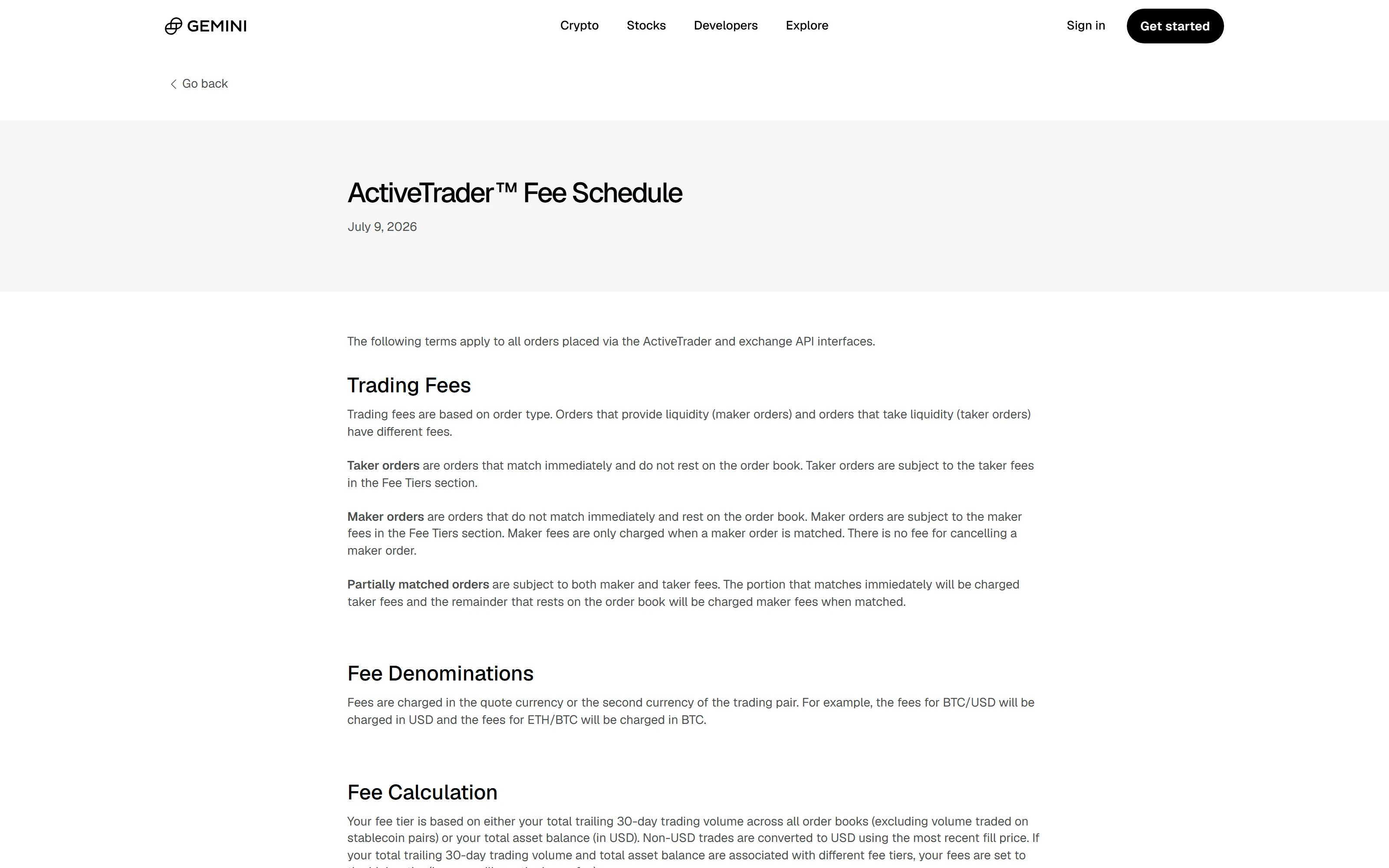
What Gemini costs you, without the marketing framing
Gemini publishes a complete ActiveTrader fee schedule, and the honest headline is that the entry tier is expensive. Below $10,000 of 30-day volume you pay 0.600% as a maker and 1.200% as a taker.
To put that in proportion, a $1,000 market buy of bitcoin costs about $12 in fees. The same order on <a href="/reviews/bybit-review/">Bybit</a> at its VIP 0 rate of 0.10% costs about $1.
The schedule falls quickly with volume. At $10,000 of 30-day volume you move to 0.400% and 0.800%, and at $75,000 you reach 0.125% and 0.250%. But that first tier is where almost every retail user lives, permanently.
Stablecoin pairs are the exception and they are genuinely free. RLUSD/USD, USDC/GUSD and GUSD/USD are 0.00% on both sides, and other stablecoin pairs are 0.00% maker with a 0.01% taker fee.
The two Geminis, and why the fee page only describes one
Gemini runs two pricing models under one brand, and the difference between them is the single most expensive thing a new user can fail to notice.
ActiveTrader
The order-book interface, priced on the published maker-taker schedule above. Limit orders, market orders, and the full tier ladder. This is the interface the fee page documents.
The simple buy interface
The default mobile and web experience. It prices through a convenience fee and a spread rather than the maker-taker schedule, and that pricing is not on the ActiveTrader fee page.
Why we are not quoting a number for it
We could not source the current Instant convenience fee and spread from Gemini's own documentation on August 17, 2026. Secondary sites quote figures freely. We will not repeat a number about your money that we have not read on the vendor's page.
What to do about it
Use ActiveTrader. It is the same account and the same assets, it is a toggle in the interface, and on the simple interface you are paying an undisclosed spread on top of whatever the stated fee is.
The regulatory case, which is the actual reason to be here
Gemini is a New York limited-purpose trust company chartered by the New York State Department of Financial Services. That is a stronger legal structure than the money-transmitter licences most US exchanges hold.
A trust charter carries capital requirements, examination by a banking regulator, and a fiduciary framework around custodied assets. It is the reason institutions with a compliance department will use Gemini and not a cheaper offshore venue.
For a retail buyer holding four figures, that structure is worth something, but it is worth asking how much. You are paying roughly twelve times Bybit's entry rate for it.
The reasonable read: if you are buying and self-custodying promptly, the premium buys you very little, because your coins leave the venue within the hour. If you are holding a meaningful balance at the exchange, the charter starts to matter.
Gemini Earn, stated precisely
In 2022 Gemini Earn users lost access to roughly $900 million in assets. It is the defining trust event for the brand and it is routinely described inaccurately.
Earn was a yield product that lent user assets to Genesis Global Capital. When Genesis halted withdrawals during the collapse that followed the FTX failure, Earn users could not withdraw. Gemini's exchange and custody were never compromised.
The distinction is real and it cuts both ways. Gemini was not hacked, and no core custody failed. Gemini also marketed a product whose risk sat entirely with a counterparty, and its users bore that risk.
A settlement returned assets to Earn users, and the New York Attorney General brought an action over the product's marketing. We have not verified the final settlement figures against primary filings, so treat the recovery details as reported rather than confirmed here.
The lesson generalizes past Gemini: a yield product is a loan to somebody, and the regulatory standing of the venue offering it does not transfer to the borrower.
Who Gemini is actually right for
There is a real case for Gemini, and it is narrower than its marketing suggests.
US institutions and compliance-bound buyers
The NYDFS trust charter is the product. If your mandate requires a regulated custodian, the fee premium is a cost of doing business rather than a bad deal.
Stablecoin-heavy users
Zero-fee stablecoin pairs are genuinely competitive, and GUSD issuance sits inside the same regulated structure.
High-volume traders willing to climb
At $1M of 30-day volume you pay 0.050% and 0.100%, which is a normal market rate. Reaching that tier is the hard part.
Almost no low-volume retail buyer
If you are buying a few hundred dollars of bitcoin a month and moving it to a hardware wallet, you are paying a large premium for a regulatory structure you barely touch.
Your situation, our answer
If this is you, do this
You buy a few hundred dollars of crypto a month
Look elsewhere first
The 1.200% entry taker fee is the most expensive of the major venues we have priced. See our cheapest way to buy crypto guide.
You need an NYDFS-regulated custodian
Gemini is a strong answer
The trust charter is a genuinely higher bar than a money-transmitter licence and few competitors hold one.
You are already on Gemini and use the mobile app
Switch to ActiveTrader today
Same account, same assets, published fee schedule instead of an undisclosed spread. This is the highest-value change on this page.
You mostly move between stablecoins
Gemini is competitive
RLUSD/USD, USDC/GUSD and GUSD/USD are 0.00% on both sides.
You are looking for a yield product
Understand what you are lending
Earn was a loan to Genesis. Any yield product is a loan to someone, and the venue's licence does not cover the borrower.
You trade over $1M in 30 days
The pricing becomes normal
0.050% maker and 0.100% taker is a competitive rate by any standard.
The honest ledger
Pros and cons
What we like
- New York trust charter under NYDFS supervision, a higher bar than a money-transmitter licence
- Complete, readable, publicly posted ActiveTrader fee schedule
- Zero-fee trading on RLUSD/USD, USDC/GUSD and GUSD/USD pairs
- No breach of the core exchange or its custody
- Genuine order-book trading with real order types on ActiveTrader
- Fees reach competitive levels at high volume, 0.050% and 0.100% at $1M
What to watch
- The 0.600% / 1.200% entry tier is the most expensive of the major venues we priced
- Simple-interface pricing is not published on the fee page, so most retail users cannot see what they pay
- The default mobile experience is the expensive one
- Gemini Earn cost users access to roughly $900 million through a counterparty failure
- Fewer listed assets than Binance or Kraken
- The regulatory premium buys little if you self-custody promptly after buying
Show your working
How we scored this review
This is a documentary review. Every figure above was read from published documentation on August 17, 2026 and is cited. We did not open a funded account, and we do not claim hands-on testing we did not do.
| Criterion | Weight | Mark | Why |
|---|---|---|---|
| Cost at retail size | 30% | 1.8 | The entry ActiveTrader tier is 0.600% maker and 1.200% taker below $10,000 of 30-day volume. That is the most expensive entry tier of any major regulated venue we have priced. |
| Regulatory posture | 20% | 4.7 | A New York trust company chartered by the NYDFS, which is a materially higher bar than a state money-transmitter licence. SOC 2 audits and segregated custody follow from that structure. |
| Security record | 20% | 4.4 | No breach of the core exchange. The 2022 Gemini Earn failure was a counterparty collapse at Genesis, not a compromise of Gemini custody, and the distinction matters. |
| Fee transparency | 15% | 3.2 | The ActiveTrader schedule is published in full and is easy to read. The mobile and web convenience pricing that most retail users actually pay is not on that page. |
| Product depth | 15% | 3.8 | Real ActiveTrader order types, a credit card, staking, and stablecoin issuance. Fewer listed assets than Binance or Kraken. |
Weights total 100. Weighted average: 3.4 / 5. Read our editorial policy.
What we could not verify
- The Gemini Instant convenience fee and spread on the simple mobile and web interface. Not present on the ActiveTrader fee schedule we read on August 17, 2026, and we will not repeat a secondary-source figure about trading costs.
- Final Gemini Earn settlement amounts and the current status of the New York Attorney General action. Widely reported, not confirmed here against primary filings.
- The current count of listed assets. We did not verify a number against Gemini's own asset page.
- Fiat deposit and withdrawal fees by method, including wire and ACH, which sit outside the ActiveTrader schedule.
- Staking commission rates and the assets currently supported for staking.
Gemini FAQs
Is Gemini safe?
Gemini is a New York limited-purpose trust company chartered and examined by the NYDFS, which is a stronger legal structure than the money-transmitter licences most US exchanges operate under. The core exchange and its custody have not been breached. The significant failure was Gemini Earn, a yield product that lent user assets to Genesis Global Capital and left roughly $900 million inaccessible when Genesis halted withdrawals in 2022. That was a counterparty collapse rather than a compromise of Gemini custody, which is a real distinction, though it is also a product Gemini chose to market.
Why is Gemini so expensive?
The published ActiveTrader schedule charges 0.600% maker and 1.200% taker below $10,000 of 30-day volume, the most expensive entry tier among the major venues we have priced. Fees fall steeply with volume, reaching 0.125% and 0.250% at $75,000 and 0.050% and 0.100% at $1 million. The structure is built for volume, and low-volume retail buyers subsidise that. If cost is your main concern, see our cheapest way to buy crypto guide.
What is the difference between Gemini and Gemini ActiveTrader?
They are the same account with two pricing models. ActiveTrader is the order-book interface priced on the published maker-taker schedule. The default simple buy interface on mobile and web prices through a convenience fee and a spread that Gemini does not publish on its fee page. Switching to ActiveTrader is a toggle in the interface and it is the single most valuable thing an existing Gemini user can do, because on the simple interface you cannot see what you are paying.
Did Gemini get hacked?
No. The exchange and its custody have not been breached. What happened in 2022 was that Gemini Earn, a yield product, lent customer assets to Genesis Global Capital, and when Genesis halted withdrawals during the collapse following FTX, Earn users lost access to roughly $900 million. That is a counterparty failure, not a security breach, and conflating the two misstates both what Gemini did wrong and what it did not.
Is Gemini better than Coinbase?
They are close on regulatory posture and Gemini is stronger on paper with its NYDFS trust charter. Coinbase lists more assets and its Advanced interface is cheaper at retail size than Gemini ActiveTrader's entry tier. Both are expensive relative to offshore venues. If you are choosing on cost, neither wins. See our our coinbase review and our best crypto exchanges comparison.
Are Gemini stablecoin trades really free?
On the published schedule, yes for specific pairs. RLUSD/USD, USDC/GUSD and GUSD/USD are 0.00% for both maker and taker orders. Other stablecoin pairs are 0.00% maker and 0.01% taker. This is one area where Gemini is genuinely competitive, and it is consistent with the venue's position as an issuer of a regulated dollar stablecoin.
Does the NYDFS trust charter protect my money?
It imposes capital requirements, examination by a banking regulator, and a fiduciary framework around custodied assets. It does not make crypto holdings risk-free and it is not deposit insurance on your crypto. It also did not extend to Gemini Earn, where the risk sat with Genesis. The charter is meaningful for how the exchange holds assets, and it says nothing about what any yield product does with them.
The bottom line
Should you use Gemini?
Use Gemini if a regulator requires it or if you keep a meaningful balance on an exchange, and switch to ActiveTrader the moment you open the account. If you are a retail buyer moving coins to self-custody, the trust charter is protection you are paying for and barely using, and cheaper venues do the same job.
This page currently carries no affiliate links. Affiliate disclosure. Nothing here is financial advice. Crypto is volatile and you can lose money.
Related